
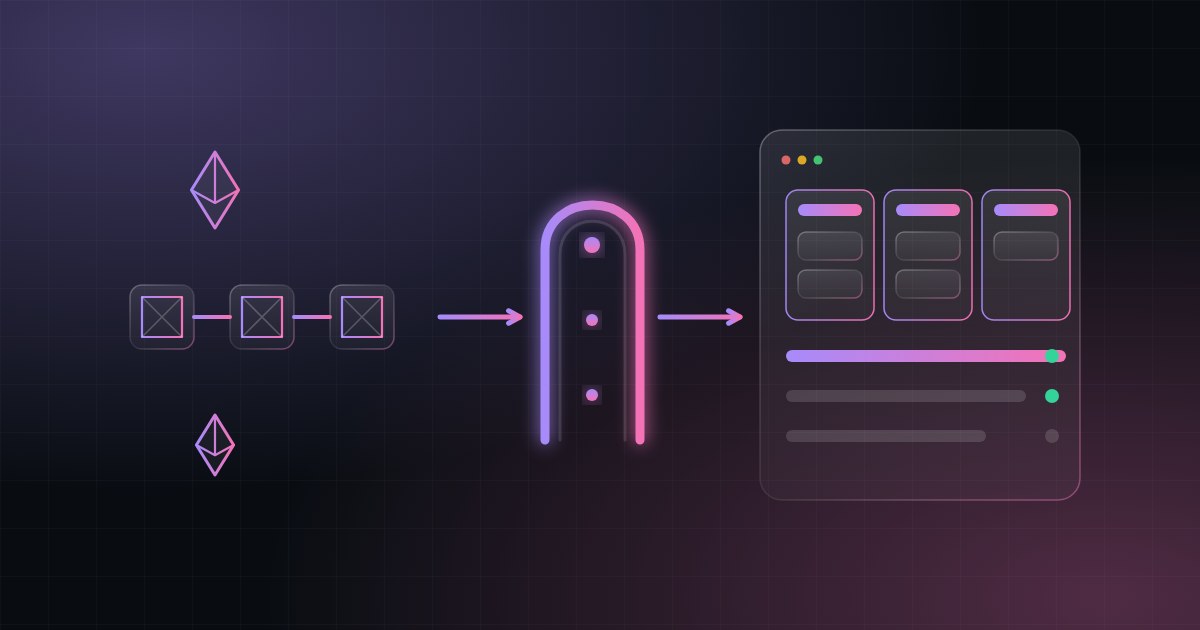
Smart Contracts Meet ERP and CRM: Connecting On-Chain Data to Your Business Processes
Architecture, real scenarios, accounting, security, and Iran versus global considerations for wiring smart contracts into ERP and CRM without duplicate or mismatched records.
Quick answer
To connect a smart contract to an ERP or CRM, treat the contract as an event source: a middle service (a listener or indexer) reads valid events from the chain after enough confirmations, validates and maps them, and posts them through an API to the ERP (accounting entries, stock, settlement) or the CRM (deal and customer status). The ERP and CRM never talk to the blockchain directly and private keys must never live inside them; the middle layer prevents duplicate and mismatched records through unique transaction keys, error handling, periodic reconciliation, and monitoring.
Why connect a smart contract to your ERP and CRM?
Blockchains and smart contracts are good at one thing: recording and enforcing shared rules between parties that do not fully trust each other, such as payments, escrow, or ownership of an asset. But your business is not only settlement; it has invoices, stock, customers, pricing, delivery, and reporting, and those live in the ERP and CRM.
If the two worlds are not connected, someone has to open blockchain transactions every day, match them to invoices, and key them into accounting by hand. That is slow and error-prone, and it quickly drifts back to the spreadsheets an ERP was meant to remove. A proper integration turns every important on-chain event into the right internal record, automatically and traceably.
Three practical scenarios
This pattern shows up most often in a few real situations. In all three the smart contract does only part of the job and the rest is coordinated with internal systems.
- Invoice payment with a stablecoin: a contract or receiving address records the payment, and after enough confirmations the middle service settles the invoice in the ERP and creates the accounting entry
- Milestone escrow for a project: each delivered milestone releases part of the funds, and the CRM moves the deal from awaiting payment to in progress or delivered
- A token-based loyalty program: points or loyalty tokens are issued on-chain and the CRM links them to the customer profile and later campaigns
- Supply-chain tracking: shipping and delivery steps recorded on-chain update stock and order status in the ERP
The recommended architecture: a middle layer, not a direct link
ERPs and CRMs were not built to handle blockchain transactions. Most connect to outside systems through APIs, webhooks, or middleware, and the same route is right for a blockchain. Put a dedicated service between the chain and the internal system that does only this job.
The main pieces of that layer are simple, and each one prevents a specific class of failure.
- Event listener or indexer: reads contract events from one or more RPC providers
- Queue and worker: processes an event after enough confirmations and retries on failure
- Mapping and validation: matches amount, currency, and invoice or order id against the internal record
- Idempotency key: combines the transaction id and log index so an event is written to the ERP or CRM only once
- ERP/CRM connector: every write goes through the official API with narrowly scoped permissions
- Reconciliation and monitoring: a nightly job compares both sides and flags mismatches
From chain to ERP/CRM: the details that cause errors
The simplest mistake is settling an invoice the moment you see a transaction. A transaction without enough confirmations can disappear in a chain reorganization. The safe rule is to record only after a defined number of confirmations for that network and, before that, show at most a pending status.
The next issue is matching. If a payment carries no sign of the invoice, automatic matching is hard. It is better to attach the invoice id in the contract's event data, or to use a dedicated receiving address per invoice. Underpayment, overpayment, or the wrong currency also need a defined path: neither full automatic settlement nor ignoring it, but a handoff to human review.
From ERP/CRM to the contract: keys and approvals
The reverse direction is more sensitive because money leaves your system here. Private keys must not live inside the ERP, the CRM, or their databases. Route outgoing transactions through a signing service or a multisig wallet, define amount limits and an allowlist of destinations, and require human approval above a threshold.
Every payment request needs a unique id so that a retried request (for example after a network error) does not send funds twice. And record everything: who approved it, which ERP record it was based on, and what the transaction id was.
Accounting and personal data
For accounting, store each transaction with its transaction id, currency, amount, and the conversion rate at posting time so it can be audited later. How digital assets are recognized for accounting and tax depends on each country and should be settled with your accountant or tax adviser; this article is not financial or legal advice.
Personal data is the other key point. Whatever is written to a blockchain stays almost forever. Never write a customer's name, phone number, email, or any personal data on-chain; put only an anonymous identifier or a hash on-chain and keep the real data in the CRM and ERP.
Iran and global markets: choosing the ERP and CRM
In global markets, options such as Odoo, ERPNext, NetSuite, Microsoft Dynamics, or SAP for ERP and HubSpot, Salesforce, Zoho, or SuiteCRM for CRM are common, and all offer APIs or webhooks. In Iran, domestic accounting and ERP products such as Sepidar, Holoo, or Rahkaran focus mostly on local tax and financial needs, and connecting them to a blockchain is usually done through a custom middle service. Ask each vendor about capabilities and APIs before deciding and test on a trial version.
For businesses operating in Iran or serving Iranian users, sanctions and payment restrictions can limit access to some cloud services and international payments. A self-hosted open-source ERP and CRM usually creates less dependency and keeps data with you. We do not give legal advice; check the rules on crypto, sanctions, and payments with official sources and a qualified lawyer before building.
Rollout: from read-only to automated
The lowest-risk way is to build the integration in stages and reconcile each stage against a human check.
- 1. Read-only: show chain events on a dashboard and compare them with ERP/CRM records
- 2. Draft: create the record as a draft in the ERP/CRM and have a person confirm it
- 3. Automatic posting: enable direct posting for simple, low-value cases and send unusual ones to review
- 4. Two-way: send payment requests from the ERP/CRM back to the contract with secure approval and signing
- Test every stage first on a test network and a sandbox ERP/CRM
The takeaway
Smart contracts and ERP/CRM are not rivals; one solves settlement and trust between parties and the other holds the operations and memory of the business. Connecting them safely takes a simple middle layer, a unique key for every event, enough confirmations before posting, and periodic reconciliation.
If you plan to connect a smart contract or a dApp to your ERP and CRM, the Sosho Studio team can help with the architecture, building the contract and the middle service, the APIs, and the dashboard. Tell us your goal and current systems through the contact section.
Frequently asked questions
Can an ERP or CRM connect to a blockchain directly?
Most do not natively read blockchain transactions. The usual approach is a middle service that reads events and sends them to the ERP or CRM through an API or webhook. Ask each vendor about its capabilities.
When is it safe to settle an invoice?
Only after a defined number of confirmations for that network. Before that, show only a pending status, because an unconfirmed transaction can vanish in a chain reorganization.
Can customer data be written on the blockchain?
It is not recommended. Data on a blockchain is effectively permanent. Put only an anonymous identifier or a hash on-chain and keep the real customer information in the CRM and ERP.
Where should the private key be kept?
Outside the ERP and CRM, in a secure signing service or a multisig wallet, with amount limits, an allowlist of destinations, and human approval for large amounts.
Where should we start?
With one small read-only scenario: show chain events on a dashboard and compare them with the ERP or CRM. Then move to drafts with human approval and finally automatic posting.